
Better Parts Through Hybrid Manufacturing
3D printing alone doesn't always win. When tolerances are tight, surface finish matters, or volumes are climbing toward a mold, we bring in the right traditional processes to get the result your part actually needs.
Certified Quality Management
ISO 9001:2015
Why not just print it?
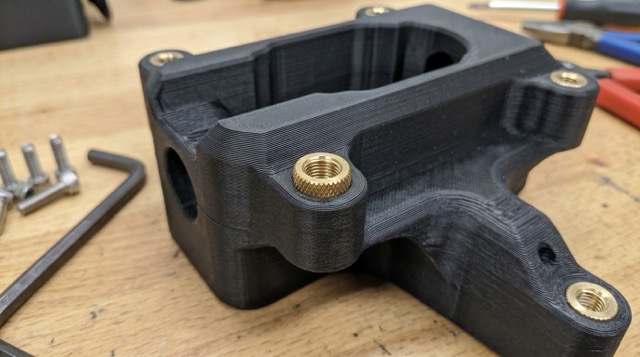
Additive manufacturing is a powerful tool, but it's not always the complete answer. A hybrid approach combines 3D printing with CNC machining, molding, casting, or composite layups to deliver performance that neither method achieves alone.
Better Performance
Print the complex geometry additive does well. Machine or reinforce the features that demand precision, strength, or sealing surfaces. Get a part that performs, not a compromise.

Lower Cost
Printing an entire large component can be slow, expensive, and material-intensive. Hybrid means printing only what needs to be printed, and using traditional methods where they're faster and cheaper.
.svg)
Faster Production
The right process for each feature, in parallel where possible. No waiting on a single bottleneck process to handle every aspect of a complex part.
Is Hybrid Right for Your Part?
Hybrid manufacturing isn't always the answer and we'll tell you when it isn't. Here's how to think about it.
Hybrid Makes Sense When...
The part has both complex geometry and precision-critical features
As-printed surface finish won't meet sealing, mating, or cosmetic requirements
The part is large and only a portion of its volume justifies additive
Load conditions or fatigue requirements exceed what AM orientation can support alone
You need threaded features, press-fit bores, or tight-tolerance datum surfaces
Pure Additive Makes Sense When...
Extreme accuracy is not necessary
Printed finish is good enough for the application
Low to medium quantities
Load configurations fit AM's capabilities
No need for threaded features in the structure
FAQs
No. If you have a physical part, we can 3D scan it and reverse-engineer the geometry. If you have an old drawing, even a hand sketch, we can work from that too. A CAD file is helpful but not required to start the conversation.
That's exactly what the initial conversation is for. The right process depends on your material requirements, operating environment, geometry, tolerance, and end-use load conditions. We'll walk through that with you and recommend the approach. You don't need to arrive with a process already in mind.
In most cases, yes and sometimes we can improve on it. Original parts were often designed with manufacturing constraints in mind. Additive manufacturing removes some of those constraints, which can mean a lighter, stronger, or more resilient geometry than what was originally produced.
It depends on complexity. A straightforward plastic part with existing geometry can be printed and shipped in days. Parts that require scanning, reverse engineering, material selection, or post-processing take longer. We'll give you a realistic timeline after the initial review — and we won't overpromise.
No. We work with customers who need one part as much as those who need a hundred.